Emirates Is Building a Robot That Scans Faces, Weighs Bags and Tags Them
Zeta42 · 22 September 2026
Emirates says a luggage robot that identifies passengers by face, weighs their bags and tags them will be showcased and launched in the first quarter of 2027.
What Emirates announced at ForsaTEK 2026
Emirates Group is developing a luggage robot that will identify a passenger by face, accept their bag, weigh it and attach the baggage tag automatically. Keenan Hamza, Vice President of Innovation and New Technologies at Emirates Group, disclosed the project at ForsaTEK 2026, which runs at the group's headquarters in Dubai on 21 and 22 September, Arabian Business reported.
Emirates plans to showcase and launch the robot in the first quarter of 2027. The idea behind the design is consolidation. Identity verification and physical baggage handling happen in a single passenger interaction, which moves several airport processing tasks into one automated unit.
How the new robot builds on Sara, the check-in assistant
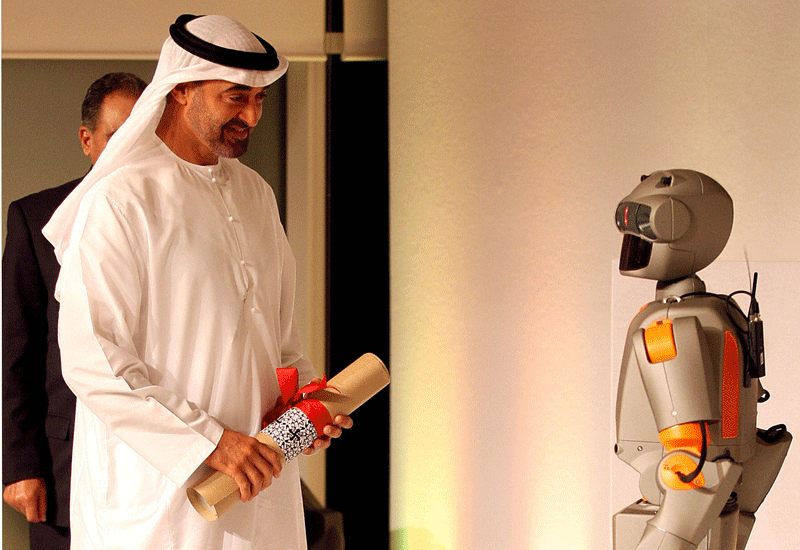
The luggage robot grows out of work Emirates has already done with Sara, its robotic check-in assistant. Sara matches a passenger's face with a scanned passport, completes the flight check-in and then directs the traveller towards the luggage drop. Sara remains deployed through Emirates City Check In and Travel Store in Dubai International Financial Centre. Emirates also offers self-service kiosks, staffed desks and off-airport baggage processing across Dubai.
The new hardware carries that sequence one step further. As Hamza described it, the robot recognises a passenger as they approach, scans their face and receives the bag. The equipment then weighs the bag and attaches the tag. For the traveller, the identity check and the bag drop become one stop at one machine.
A robotics lab built to move trials into operations
The robot comes out of a specialised robotics lab the group has set up to develop automation for passenger operations, cargo services and logistics. Hamza tied the luggage project directly to that lab and to the group's wider technology programme.
Other ForsaTEK projects point the same way. Emirates Group presented a system that uses drones to inspect engine components, part of its work on automated aircraft maintenance inspection. Hamza described it as a regional first. "We are the first entity in the region to do this," he told reporters. In cargo, the company has already automated pallet dimension measurement.
The detail worth noting is the pace. Hamza said several technology concepts discussed or tested two years earlier have since entered operational use across the business. The lab's job is to move more projects from trials into airport, cargo and logistics workflows.
AI that learns what passengers like to eat and drink
The robotics sits next to a data project. Emirates is using artificial intelligence to process passenger preference data across its service functions, and Hamza outlined a plan to use historical customer information to anticipate individual requirements before travellers ask. Food and drink preferences are part of that work.
"By leveraging artificial intelligence solutions, we aim to provide the best service and quality for individuals, and to understand what travellers like and prefer to eat and drink," Hamza said. The systems in development are meant to recognise previous preferences and surface relevant service options on future journeys, drawing on AI, biometric identification and passenger data together.
The spending behind the automation
Emirates has the balance sheet for this kind of work. For the financial year ended 31 March 2026, the group reported record revenue of $41.0 billion (AED 150.5 billion), up 3 per cent, and profit before tax of $6.6 billion (AED 24.4 billion), according to Arabian Business. Cash assets, also a record, climbed to $16.2 billion (AED 59.6 billion). Group investment in aircraft, facilities, equipment and technology reached $4.9 billion (AED 17.9 billion) during the 2025 to 2026 financial year.
What the luggage robot says about robotics skills in the UAE
Take away the airport and the luggage robot is a classic robotics problem. It has to recognise a person, handle a physical object, measure it and act on it, in front of passengers, one after another. Each of those steps is manageable on its own. Making them work together, every time, is where the engineering lies.
That is the kind of thinking Zeta42 wants younger learners to pick up when they build and program robots: a camera, a sensor and a mechanism only become useful when software ties them into one reliable sequence. For professionals, the lesson is about timing. If concepts tested two years ago are in operation today, the people who can design, run and maintain systems like this in the UAE are needed now.
Source: arabianbusiness.com