Industry
A job done, at a rate you can plan around.
A factory does not buy a robot. It buys a job being done, at a rate it can plan around, by people who already work there. Everything else is detail.
We assess the job, supply the robot, integrate it and train the team. A factory can have a working robot within days.
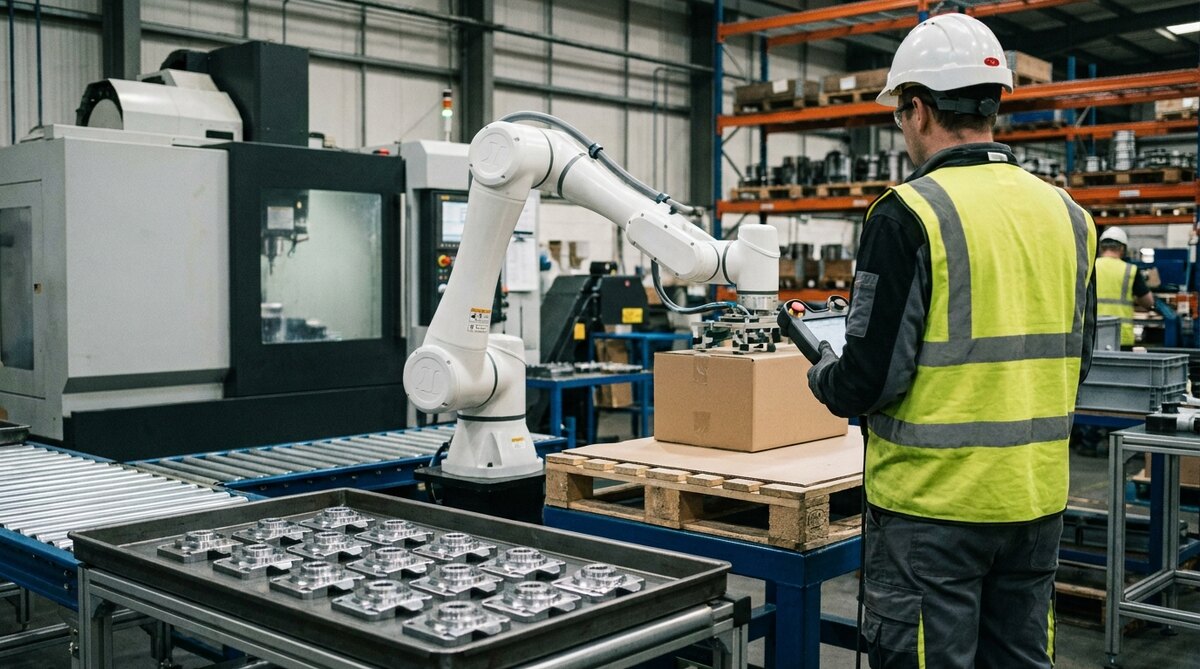
What automates first
Start with the dull jobs.
The work that automates first is the work nobody wants: the same motion, the same part, all shift. If a person has been doing that for a year, it is worth timing. Where the work varies more than that, the honest answer is often not yet.
What we supply
Arms, cells and humanoids.
Which of these three you need is usually obvious within a minute of describing the task, which is why the assessment visit is short and the quote comes after it rather than before.
Collaborative robot arms
0.5 to 30 kg. Skin-sensing models that stop before contact. Washdown models for food and pharma.
The armsReady-made work cells
Palletizing set up in 30 minutes with no code. Welding, screwdriving and machine-tending packages.
Work cellsHumanoids and research rigs
Dexterous hands for material handling, assembly research and AI training data.
HumanoidsApplications
Where cobots pay off.
If the job is on this list, somebody has already made it pay. That is not the same as it paying for you, which is what the timing visit is for.
- Machine tending
- Palletizing
- Welding
- Screwdriving
- Pick and place
- Packaging
- Quality inspection
- Polishing and sanding
- Laboratory automation
- Food and beverage
- Pharmaceuticals
- Electronics
- Automotive parts
- Metal fabrication
- Warehousing
- Hospitality and retail
DOBOT publishes 6 to 12 months payback for machine tending and 8 to 10 months for palletizing.
Figures are DOBOT's published data. Performance figures are laboratory results and can differ in use.
How a job runs
Five steps, from the site visit to the service call.
- 01
Assess
Site visit. We time the task and pick the robot.
- 02
Supply
Robot, gripper, vision and cell from one partner.
- 03
Integrate
Wired into your line, PLC and software.
- 04
Train
Operators and maintenance staff, on your floor.
- 05
Support
Service and spares, with a team in the region.
Who runs it after
It lives or dies on the floor.
What decides whether it sticks is the operators. A cell only the integrator can change becomes a cell nobody changes, and then it becomes a cell nobody uses. We train the people who will run it, on your floor, on the machine they will actually be using.
Machine tending, palletizing, welding and screwdriving cells, taught by drag-to-teach on the same cobots used on the line. Ends with the DOBOT Certificate.
Support
An engineer, not a shipping quote.
Support is the part that is easy to promise and hard to do from another continent. A line stopped on a Thursday needs an engineer on Friday, not a shipping quote.
The office side
The line runs on a cell. The business runs on a spreadsheet.
The odd thing about automating a factory is how quickly the bottleneck moves to the office. A cell that runs perfectly still waits on a purchase order somebody has to chase by email.
Most factories that ask about a robot also run production on a whiteboard, procurement in email and the month-end on a spreadsheet only one person can open. The same team that commissions the cell builds the system behind it: production boards, procurement and approvals, maintenance logs, payroll.
One construction business replaced 40+ spreadsheets and three off-the-shelf tools with a 35-module ERP that 150+ people use every day. Project tracking, procurement, billing, payroll and compliance on one source of truth.
Ecosystem
What bolts on.
Plus the DOBOT+ ecosystem: grippers, smart cameras and 3D vision, force sensors, sanding heads, Siemens PLC integration and mobile bases.
Questions
What plant managers ask.
How fast can a cobot be running?+
A factory can have a working robot within days. Palletizing is set up in 30 minutes with no code; a new task in five. The assessment visit tells you the real date for your job.
Is it safe next to people?+
Skin sensing detects a person 5 to 15 cm before contact and stops in 0.1 seconds. Certified to ISO 13849-1 PL d Cat 3, ISO 10218-1 and ISO/TS 15066. Cages are usually not needed; the assessment confirms it for your cell.
Who programmes it after you leave?+
Your operators. Drag the arm to teach it. We train operators and maintenance staff on your floor, on the machine they will use, and the operator track ends with the DOBOT Certificate.
What is the payback?+
DOBOT publishes 6 to 12 months for machine tending and 8 to 10 months for palletizing. We time your task at the visit and tell you if the numbers work before you see a quote.
What if the line stops?+
Service and spares from a team in the region. A line stopped on a Thursday gets an engineer, not a shipping quote.
Can you also fix the spreadsheets?+
Yes. The same team builds the production and procurement systems around the cell.
We come out and time the task before quoting it. If the numbers do not work you will hear that at the visit rather than after the invoice.