Universities and colleges
Industrial robots for the engineering lab.
Cobot teaching labs, PLC training cells and research platforms. The robots students learn on are the ones factories run.
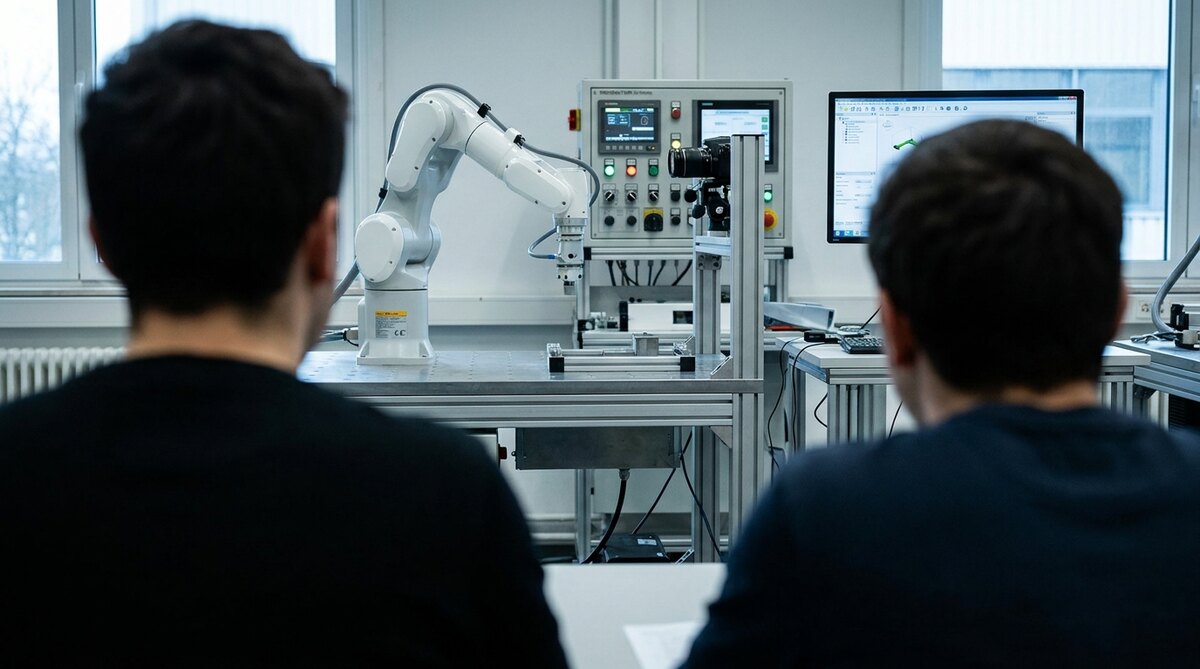
Two buyers
Two buyers in one department.
A university buys for two reasons at once, and they pull in opposite directions. Teaching wants equipment that survives a cohort and matches what industry runs. Research wants a platform open enough to take apart and instrument.
Three offers
Teaching lab, research platform, and the people to run both.
Most departments want two of these three and discover they needed the third. The teaching lab and the research platform are different purchases with different budgets, and the staff who will run both are usually nobody's line item.
Teaching lab. Cobots and PLC cells.
Six-axis cobots and training stations, desktop industrial cobots, education packages and a universal training platform with Siemens PLC. Pick and place, vision, grippers, assembly lines.
The armsResearch platform. Humanoids and data rigs.
Bimanual data-collection cells, humanoids, walking robots and skin-sensing cobots for shared lab space. Open Python API, ROS, SDK onboarding and data pipelines.
Humanoids and rigsFaculty and student training.
Operator and drag-to-teach workshops. AI Foundations and AI at Work for faculty and admin teams. Short courses through career centres and student clubs.
TrainingTrusted by
405 universities got there first.
Another 378 universities and institutes worldwide run DOBOT robots in published research, from Imperial College London to KAUST. The full list is available on request.
The reason to publish this figure rather than a testimonial is that it is checkable. Every one of these institutions put its name to a paper, not to a quote in a brochure.
Institution marks identify published research and teaching use of DOBOT robots. They do not imply endorsement of Zeta42 or DOBOT.
For teaching
The kit industry actually runs.
For teaching, the argument is continuity. Students who learn on the arms that factories actually run graduate employable, and a department teaching on one family from first year to final project is not retraining itself every September.
For research
Access beats polish.
For research, the argument is access. A platform that hides its control stack is a demonstration rather than an instrument, and a final-year project that cannot reach below the interface is a project about the interface.
- Cobot programming, vision and force control for engineering and computer-science degrees.
- Final-year projects and research on humanoids and data-collection rigs.
Faculty first
Staff before students.
In practice faculty come first. A department that has never run a cobot cannot supervise a project on one, so the useful sequence is almost always staff, then curriculum, then students.
Operator and drag-to-teach workshops. AI Foundations and AI at Work for faculty and admin teams. Short courses through career centres and student clubs.
Vocational and TVET
Operator skills that certify.
Technical and vocational colleges usually want something different again: employability rather than novelty, and a qualification an employer recognises on sight. That case is made better on the industry page, which is written for the people who will be doing the hiring.
How it runs
Five steps, faculty first.
A campus project is slower than a factory one and the order matters more, because a department that takes delivery before its staff are trained has bought a store cupboard.
- 01
Map
Which courses, which cohorts, which research groups, and what the lab is for in three years. We read the syllabus before we size the room.
- 02
Design
Bench layout, safety zones, the platform mix between teaching stations and research rigs, and the network the research group will need.
- 03
Supply and install
Robots, PLC platforms, grippers, vision and rigs from one partner, shipped to any of the six GCC countries, unboxed and commissioned.
- 04
Train faculty
Before students. Operator and drag-to-teach workshops for the staff who will supervise, and SDK onboarding for the research group.
- 05
Certify and support
The DOBOT Certificate for students on the operator track, DobotLab for the teaching platform, and service and spares from Abu Dhabi.
The AI side
A teaching server the whole bench can query.
Set up to serve models to every bench over the local network, for thirty people querying at once. Model library, datasets and notebooks loaded and backed up. The model, the weights and the reason it slows down are all in the room, which is the point for a department that teaches how the thing works.
Questions
What departments ask.
Is the platform open enough for research?+
Yes. Open Python API, ROS support and SDK onboarding. A final-year project can reach below the interface.
Are these the robots industry uses?+
Yes. The same DOBOT family runs on production lines across the GCC. Students graduate on the arms factories run, not on an educational version of them.
Can faculty be trained before the lab arrives?+
Yes, and they should be. Operator workshops run at our Abu Dhabi campus or on yours, and are the first step of every campus project.
Do you support research groups after installation?+
Yes. SDK onboarding, data pipelines and service from Abu Dhabi.
Which institutions already use DOBOT?+
405 universities and institutes worldwide in published research, from Imperial College London to KAUST. The full list is available on request.
We supply the platform, train the faculty, and run short courses through career centres and student clubs. Tell us which of the two problems is the urgent one and we will start there.