AI agents
Agents that read your documents and act inside your operation.
For procurement, HR and finance. Document intelligence, ops agents and back-office work.

What an agent is
It does the task, not the conversation about the task.
A chatbot answers a question. An agent reads the invoice, checks it against the purchase order and the delivery note, posts it to the right cost code and asks a person only when the three do not agree. The output is a completed step in your operation, with a record of what it did and why.
Three places
Where they earn their keep.
Procurement
Reading quotes and purchase orders, matching them to budget and vendor history, drafting the comparison the buyer used to build by hand.
HR
Reading applications against a role, preparing onboarding, answering policy questions from the actual policy document rather than from memory.
Finance
Three-way matching, expense checks, month-end reconciliation across the systems that never quite agreed.
Documents
The knowledge is in the files nobody reads.
Contracts, tenders, compliance reports, ten years of site diaries. An agent that has read them can answer the question a new employee would take a week to answer, and cite the page. Built on your documents, running where they are allowed to sit, and never trained on them for anyone else.
Running today
A director who only sees the exceptions.
Procurement approvals
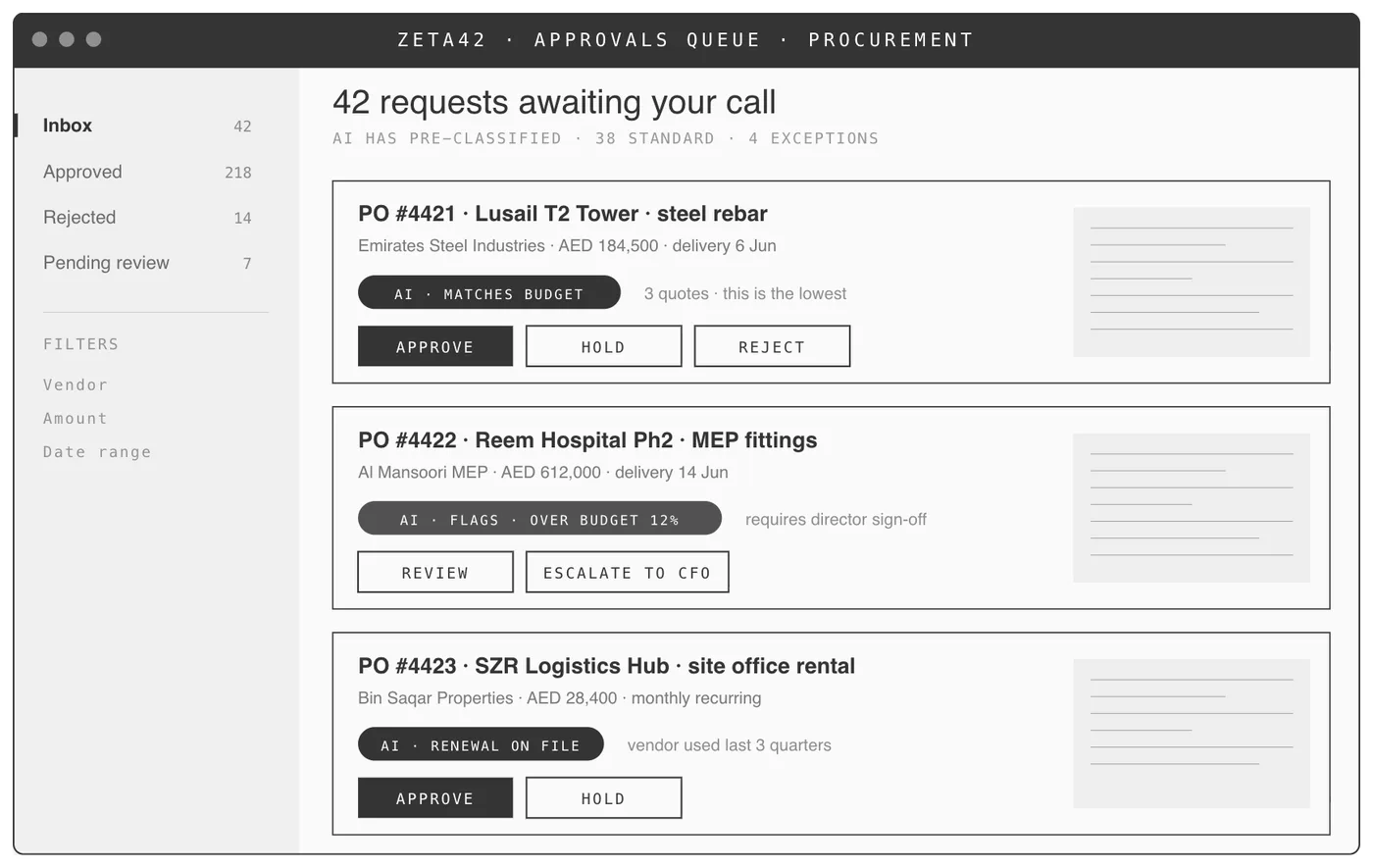
42 requests awaiting a decision, 38 classified as standard and matched automatically, four flagged as exceptions with the reason attached. The director's morning is the four, not the 42.
Control
Every action logged, every limit yours.
Agents act within limits you set: which systems they may write to, what value they may approve alone, when they must ask. Every action is logged with its inputs and reasoning. If an agent is wrong, you can see where and change the rule, not retrain a black box.

Questions
What buyers ask.
Which AI models do you use?+
Whichever fits the job and the data rules. OpenAI, Claude and Gemini through their APIs where the cloud is allowed. Open models from Hugging Face running on your own hardware where it is not.
Is our data used to train anything?+
No. Your documents stay yours. On cloud APIs we use the business terms that exclude training. On your own hardware nothing leaves the building.
Can an agent make a payment or sign a contract?+
Only if you tell it to, and only within a limit you set. The default is that money and commitments always go through a person.
How do we know what the agent did?+
Every action is logged with what it read, what it decided and why. The log is yours and is readable by an auditor.
Bring the folder of documents that only one person understands.