Schools
We design the lab, install it and teach it.
Kits arrive, get used twice and end up in a cupboard. A lab is different: it is a room that works, a curriculum that fits the timetable you already run, and teachers who are confident with it after we leave.
A robot lab is not a box of kits. It is a room, a curriculum and trained teachers. We supply all three.
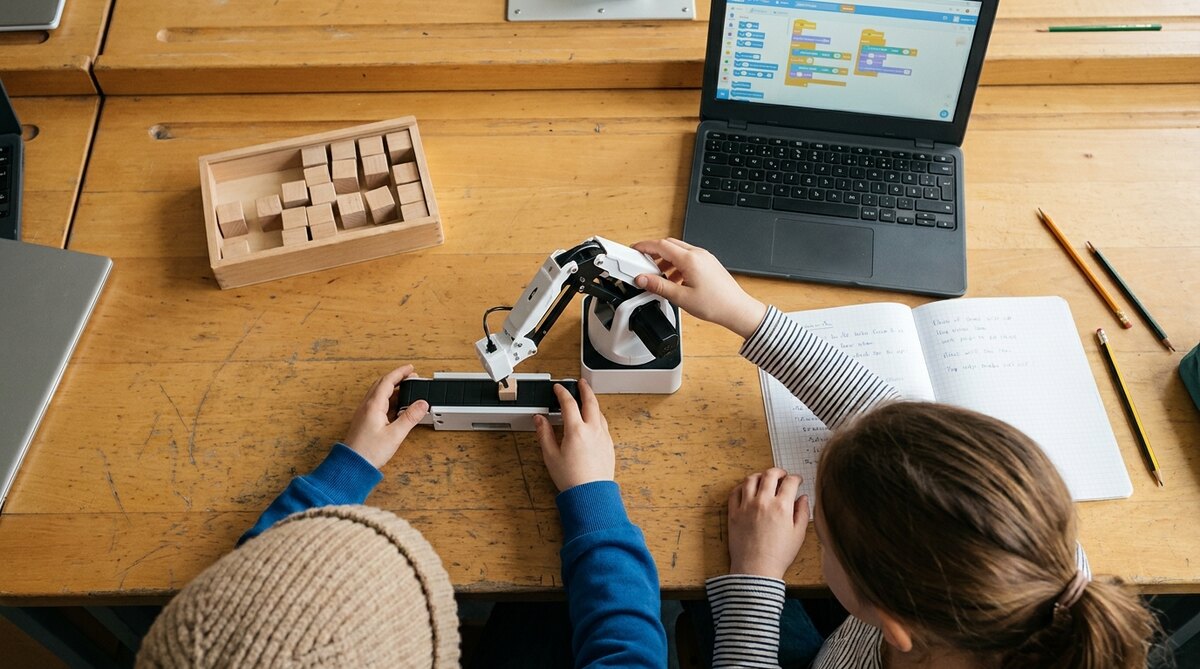
The room first
Where it actually goes.
We start with the room, because the room decides most of the rest. Where the power is, whether the desks move, how many students are in at once, what else that space is used for on a Thursday. A lab designed on paper for a room nobody visited is a lab that gets rebuilt.
Three tiers
One lab per stage of school.
Pre-KG to Grade 2
Early-years coding corner. Tangible coding robots, floor robots and themed maps. Screen-free, ready in a day.
Grades 3 to 8
Primary STEM lab. Sensor robots with AI vision and desktop arms. Block coding to first Python.
Grades 9 to 12
Secondary robotics lab. Six-axis cobots, conveyors, rails and vision kits.
No screens, no logins and no AI chatbot anywhere in this stage. A four-year-old can run it on their own after one lesson.
The kit
What arrives, by tier.
Procurement asks what arrives, and a page that answers with a philosophy loses. This is the list.
Pre-KG to Grade 2
Tangible coding robots that children programme by placing real blocks in a row. Floor robots and themed maps for reading, maths and science. Nothing needs a screen or reading.
Grades 3 to 8
Sensor robots with an LED matrix and a camera that spots faces, colours and tags. Desktop robot arms with a conveyor, a rail and a camera. Block coding to first Python.
Grades 9 to 12
Six-axis collaborative robots, conveyors, rails and vision kits. Python, pick and place, grippers and mini assembly lines. Factory skills at classroom size.
Every tier
A curriculum for each grade, teacher training, co-teaching for the first term, and the DobotLab platform. Service, spares and upgrades from Abu Dhabi.
The digital policy
A lab that fits the policy you already have to write.
Since the 2024/25 year every private and charter school in Abu Dhabi has to hold a five-year digital strategy, define digital competencies by grade, raise awareness of AI, run an age-appropriate programme on screen habits and wellbeing, and show a developmental purpose before a pupil goes online in school hours. The ADEK School Digital Policy (version 1.1, September 2024) sets this out, and asks schools to vet every external provider for data security and age-appropriateness.
A robot lab from us is built for a school working under that policy. The first two stages have no screen and no internet in them, so the question of purpose does not arise until Grade 3, when the plan names it. The curriculum is written by grade, Pre-KG to Grade 12, with an AI strand from Grade 1 that starts away from a screen and ends with pupils building with models and agents. The AI lab runs on hardware in your building: no pupil account, no third-party terms, nothing leaving the site. And we train your staff first, which is the clause most schools find hardest to evidence.
A principal reading this has to document compliance whether or not a robot ever arrives. The lab can make that easier or harder, and which one it is comes down to whether the curriculum was written against the policy or sold alongside it.
A developmental purpose before pupils go online (4.2.3)
Pre-KG to Grade 2 robotics uses no internet and no screen. From Grade 3 the screen arrives with a purpose the plan names.
Digital competencies defined by grade (3.1)
A curriculum for every grade, Pre-KG to Grade 12, with what is learned and what is made at each stage.
Awareness of emerging technologies such as AI (2.1.9)
An AI strand from Grade 1, away from a screen, to Grade 12 building with models and agents.
An age-appropriate programme on digital habits (4.2.2a)
The five AI skills taught from Grade 4: asking well, giving examples, checking, knowing when not to, and saying that you did.
Standards for responsible use of AI tools (4.1.6)
Saying that you used it is taught as a habit, the way a pupil credits a book.
Staff training (2.1.8, 3.2)
Teachers trained first, then co-taught for the first term, plus faculty and admin AI courses.
External providers vetted for data security and age-appropriateness (5.5)
An AI lab on hardware in the building. No pupil account, no third-party terms, nothing leaves the site.
Parents monitoring device use at home (4.4)
Weekend terms for the youngest add no screen time at all.
We do not certify compliance, and nobody outside ADEK can. What we can do is hand your Digital Wellbeing Lead a curriculum, a kit list and a training plan that map to the clauses, so the lab is evidence rather than another thing to document.
The AI lab
An AI lab that never calls the internet.
The robot lab is one room. The AI lab can be the same room. Desk-side machines that hold and run real models on your own network. A child's work and face stay in the building, there is no account for a thirteen-year-old, and no meter runs when a class gets interested. A lesson built on it does not stop when the internet does.
The objection to AI in a school is almost never the teaching. It is the account, the terms nobody read and the question of where a child's work went. Putting the model in the building removes all three at once.
How a lab project runs
Five steps, start to term one.
- 01
Survey
We visit the room and read the timetable.
- 02
Design
Lab layout plus a curriculum for every grade.
- 03
Supply and install
Robots and kits shipped, unboxed and set up.
- 04
Train
We train the teachers, then co-teach the first term.
- 05
Support
Service, spares and upgrades from Abu Dhabi.
Who teaches it
Your staff, not a new hire.
The hardest part of a school lab is not the robots. It is that somebody has to teach with them on a Tuesday morning. We train the staff you already have and co-teach at the start, so the lab does not quietly depend on hiring a specialist who does not exist yet.
What it becomes
A corner grows into a lab.
The same robot family carries a child from a floor robot to a six-axis arm without relearning the software at every step. That is the difference between a lab and a shelf of unrelated toys, and it is what makes the spend defensible to a board.
No hiring needed
We train the existing staff and co-teach the first term. The school does not need a robotics teacher on day one.
Grows with the school
A coding corner becomes a lab. The same robot family carries students from KG to Grade 12, then on to university and industry.
Parents see it
A showcase day each term. Students leave with badges and a portfolio, and the school has something to show at open days.
Where it leads
The same robot family, KG to the factory floor.
A child who drives a floor robot in KG programmes a desktop arm in Grade 6, a six-axis cobot in Grade 10, and meets the same cobot again in a university lab or on a production line. One software family all the way up, so nothing is a toy version of the next thing.
Questions
What principals ask.
Do we need a robotics teacher to start?+
No. We train the staff you already have and co-teach the first term. The school does not need a specialist on day one.
How long from survey to the first lesson?+
The early-years coding corner is ready in a day. A full secondary lab depends on the room and the shipping, and we tell you the date at the survey.
Does the curriculum fit our timetable?+
It is written to it. The survey reads the timetable before the lab is designed, and the curriculum is one per grade, not one per kit.
What do parents see?+
A showcase day each term. Students leave with badges and a portfolio, and the school has something to show at open days.
Can the lab run without internet access?+
Yes. Coding and robotics run locally. Where the school wants AI in the room, we install it on hardware in the building so nothing leaves the site.
Do you work outside Abu Dhabi?+
Yes. Labs are surveyed, installed and supported across the six GCC countries.
Does the lab help with our ADEK Digital Policy documentation?+
It is built to. The curriculum is by grade, the AI strand starts away from a screen and names its purpose when screens arrive, staff training is part of the installation, and the AI lab keeps pupil data in the building. We can map the kit, the curriculum and the training plan to the policy's clauses for your Digital Wellbeing Lead. We do not certify compliance; only ADEK can.
Is the early-years kit really screen-free?+
Yes. Floor robots with buttons on them and coding blocks a child picks up. No tablet, no login, no internet connection. The screen arrives in Grade 3.
Do young children use chatbots in the AI lessons?+
No. Grades 1 to 3 learn what a computer can and cannot do, away from a screen. A chatbot is first used in Grades 4 to 5, with an adult in the room, on the school's own hardware, and with the habit of checking the answer and saying they used it.
Most schools start with a survey visit. We look at the room, read the timetable and tell you what is realistic for the budget you actually have.