Families
Robots in class, from age three.
Children do not need to be persuaded that robots are interesting. What they need is a room where the robot actually works, a mentor who has built things themselves, and enough time to finish something they are proud of.
- Age 3 to Grade 12.
- Ten-week weekend terms and four-week summer camps.
- Explorers, Builders, Innovators.
- Badges, a portfolio and a showcase at the end.
How it steps up
Never a toy version.
The youngest start without a screen and without reading, placing physical blocks to make a robot move. Older children move to code, then sensors and cameras, then a real arm doing a real job. Nothing here is a toy version of the next thing, which is why the step up never feels like starting again.
Coding with blocks and floor robots
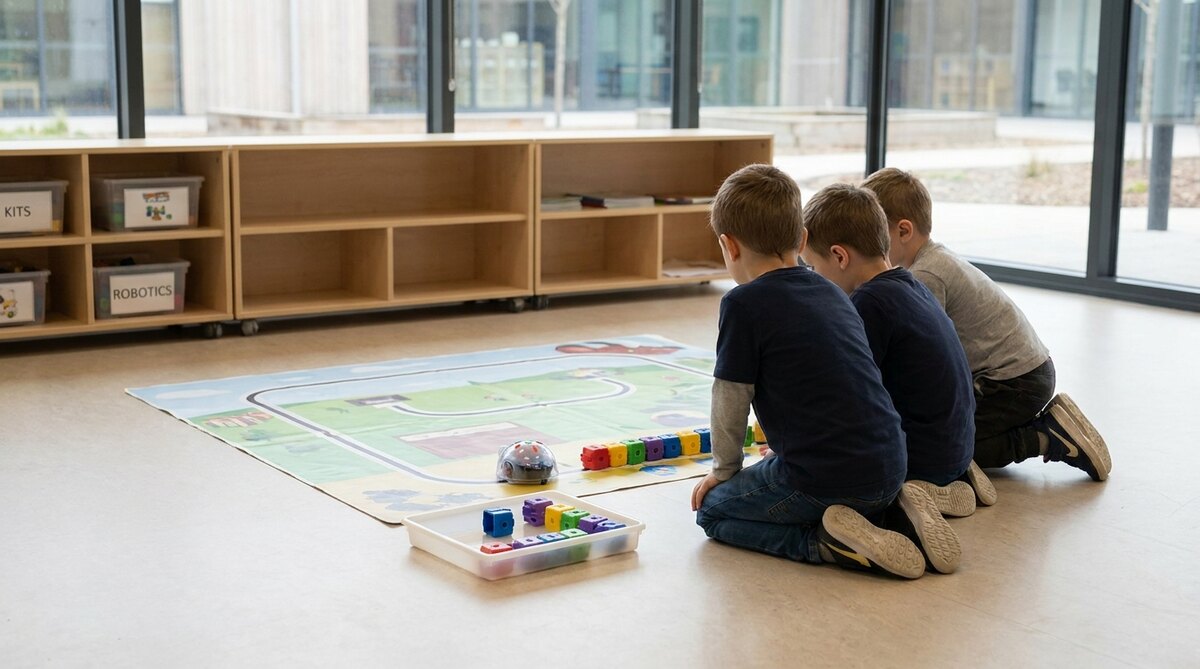
Children place real blocks in a row to program a robot, then drive a floor robot across maps for reading, maths and science. No screen and no reading needed.
Sensors, cameras and first Python
The move from blocks to code on screen. Sensors, an LED matrix, and a camera that spots faces, colours and tags.
Grades 6 to 9. AI kits and real robot arms
Machine learning, speech and self-driving on a modular kit. Then a real four-axis desktop arm with a conveyor, a rail and a camera.
Grades 10 to 12. Six-axis cobots and machine vision
Python, pick and place, grippers, vision and mini assembly lines on a real six-axis cobot. Factory skills at classroom size.
The screen question
A robotics class that adds no screen time.
Most parents who ask about these classes ask about screens in the first minute, and they are right to. The honest answer is not that screens are bad; it is that the youngest children here learn what coding is without one, because holding a command in your hand teaches it better.
Abu Dhabi's schools are now required to have a purpose before a child goes online in school hours, to teach children about the effect of screen habits on wellbeing, and to ask parents to keep an eye on devices at home. The guidance issued during remote learning this year went further: no digital homework for the youngest, and offline building projects preferred over anything on a screen.
Our classes for ages 3 to 8 are built that way already. A child programs a robot by laying blocks in a row and pressing go. The robot moves on the floor. The lesson is on a printed mat. There is no tablet, no login and no chatbot in the room. They learn what coding is, which is putting steps in order and fixing the one that is wrong, without a screen to learn it on.
From Grade 3, screens come into the room for coding and, later, for AI work, with a mentor beside them and for a purpose. Nothing is taken home to finish on a device.
How we teach
Four students per mentor.
Places every learner
Beginners start from zero. Advanced cohorts go deep. Nobody is left behind or held back.
Brings the kit
We provide the laptops, the AI tools and the accounts. Learners bring curiosity.
Keeps classes small
Four students per mentor, taught by practitioners.
What they leave with
Something they can explain.
Each term ends with something to show rather than a printout nobody reads. The child leaves with a project they built and can explain, and you get to watch them explain it.
Formats
Terms, camps and clubs.
- Weekend terms
- Summer camps
- Robotics clubs at the school
- DobotLab platform
The cycles
Explorers, Builders, Innovators.
Three school cycles, each a ten-week weekend term or a four-week summer camp. Badges as they go, a portfolio at the end, and a showcase where they explain what they built.
The cycles are the same subject at three depths rather than three different subjects, so a child who starts in one and moves up is not starting again.
A term
Ten weekends, one project.
This is the practical part a parent reads before booking: where it happens, how many children are in the room, and what the child goes home with.
Weekend sessions at the Abu Dhabi campus. Four students per mentor, taught by practitioners who have built things themselves. We provide the laptops, the AI tools and the accounts; the child brings nothing but curiosity. The term ends with a showcase, and the child leaves with a project they built and can explain.
Questions
What parents ask.
What age can my child start?+
From age 3. The youngest start without a screen and without reading, programming a robot by placing real blocks in a row.
How do you decide which group a child joins?+
By a short conversation, not by age alone. Beginners start from zero and advanced cohorts go deep, so nobody is left behind or held back.
What does my child need to bring?+
Nothing. We provide the laptops, the AI tools and the accounts.
How big are the classes?+
Four students per mentor.
Where do terms run?+
At the Abu Dhabi campus, 91 Al Ftaymi St, Al Nahyan, E25. Weekend terms during the school year and four-week camps in the holidays.
Is it safe for young children to work with robots?+
Yes. The early-years robots are floor robots and block-coding robots with no screen. The cobots teenagers use are collaborative robots designed to work next to people, and every session is supervised at four students per mentor.
Is this just more screen time?+
No. For ages 3 to 8 there is no screen at all. For older children, screens are used in the room, with a mentor, for coding and building, and nothing is set to finish on a device at home.
How does this fit with what my child's school is doing about devices?+
Abu Dhabi schools now work under a digital policy that asks for purpose before screens, awareness of screen habits, and parents keeping watch at home. A class with no screen in it is the simplest possible answer to that question.
Terms run at weekends and camps run in the holidays. If you are unsure where a child fits, we would rather place them after a short conversation than by age alone.