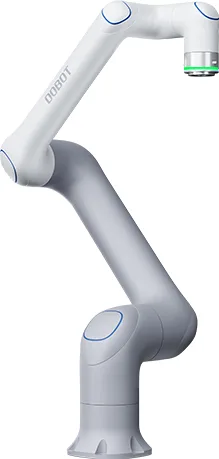
CR30HT (with Torque Sensor)
30 kg · Torque Sensor
Supplied, integrated and supported by Zeta42 across the UAE and the GCC, with the engineering to put it into a line and the training for the people who will run it afterwards.
At a glance
- Payload
- 30kg
- Reach
- 1800mm
- Repeatability
- ±0.05mm
- Sensing
- Joint torque
What it does
Built for.
- Joint torque sensors on every joint, for force-controlled work at 30kg
- One-hand drag-to-teach, which DOBOT measures as 90% faster teaching
- Instant collision detection response
- 300°/s joint speed, which DOBOT records as the highest for a heavy-payload cobot
- HyperMove motion control: 20% higher single-unit efficiency, 10 pcs/min palletizing
- Vibration suppression across the full speed and payload range
- 96V mid-voltage servo drive: 50% more power with 20% less heat
- 30% fewer components with optimised load distribution, cutting downtime by 45%
- Fail-safe electromagnetic brakes hold end-effector displacement under 1mm on power loss
- 1kHz real-time control cycle, for high-speed motion without overshoot
- Three editions: CR 30H Standard, CR 30HT Touch with joint torque sensors, CR 30H-Food Clean Edition with NSF-certified components
Where it is used
Applications.
- Food and beverage: full-case palletizing and raw material handling for dairy and frozen-food lines
- Automotive: wheel hub handling, seat assembly and battery module transfer
- Metal processing: heavy workpiece handling and laser cutting
- Semiconductor: wafer handling and packaging
Specifications
The full sheet.
- The same CR 30H arm underneath, so unless a line says otherwise the figures below are DOBOT's published CR 30H specifications
- Built-in joint torque sensors on every joint
- Weight 102kg on the supplier sheet, against 98.5kg for the standard CR 30H
- IP65 on the supplier sheet; DOBOT publishes IP67 for the CR 30H body and describes the series as IP65/IP67
- Max payload 30kg
- Working radius 1800mm
- Repeatability ±0.05mm
- Noise level 70dB(A)
- Operating temperature 0~50℃
- Joint motion range J1/J2/J4/J5/J6 ±360°, J3 ±163°
- Max joint speed J1/J2 150°/s, J3 200°/s, J4/J5/J6 300°/s
- Mounting floor, wall or ceiling, on a 6m body-to-cabinet cable
- Materials aluminium alloy, ABS and rubber
- End I/O 0/12/24V at 2A average and 3A maximum, 4 DI, 4 DO, 1 RS485
- Control cabinet 400 × 190 × 400mm, 19kg, single-phase 200-240V AC 50/60Hz
- Cabinet I/O 24 DI and 24 DO (NPN/PNP), 2 AI and 2 AO at 0-10V or 4-20mA, 10 safety inputs and 10 safety outputs
- Cabinet IP20, optionally IP54, fan cooled, humidity ≤95% non-condensing
- 2 × Ethernet (TCP/IP, Modbus TCP, EtherNet/IP, Profinet), 1 × RS485 Modbus RTU, 2 × USB, 1 × ABZ incremental encoder
- Teach pendant 10.1in 1900 × 1200 at 60Hz capacitive, Android, 4GB + 32GB, IP54, 1.09kg
- SGS-verified cybersecurity compliance with ISO 10218-1:2025
Figures published by DOBOT. Performance figures are laboratory results and vary with the application.
Specifications published by DOBOT: CR 30H Collaborative Robots on dobot-robots.com.
In the same range
Collaborative robot arms.
- CR5AP
- CR10AP
- CR20AP
- CR5AF
- CR10AF
- CR20AF
Specification sheets answer the second question. The first one is usually whether a robot suits the job at all, and that is answered by watching the task rather than by reading a table, which is what an assessment visit is for.
Pricing is quoted case by case.